Grating Stair Treads
Fabricated grating stair treads — serrated or plain surface, welded or bolted carrier plates, anti-slip nosing — in hot-dip galvanized steel, 304/316L stainless and FRP, dimensioned to OSHA 1910.25 and EN ISO 14122-3.
Get a Quote Download CatalogStandard tread sizes (US customary)
Screenshot-ready. Every dimension below is a standard tooling size — custom spacings are cut to your drawing at no extra mold cost.
| Tread width | Depth (clear) | Bar section | Weight (kg/pc) | Fixing |
|---|---|---|---|---|
| 24″ (610 mm) | 9.5″ (241 mm) | 25×3 / 32×3 | 6.8 | Bolted carrier |
| 30″ (762 mm) | 9.5″ (241 mm) | 25×3 / 32×3 | 8.2 | Bolted carrier |
| 36″ (914 mm) | 9.5″ (241 mm) | 32×3 | 9.6 | Welded or bolted |
| 42″ (1067 mm) | 9.5″ (241 mm) | 32×3 | 11.1 | Welded or bolted |
| 48″ (1219 mm) | 9.5″ (241 mm) | 32×5 | 15.4 | Welded |
These are steel-grating treads (open mesh) — not checker plate. For platform-tread landings in the same family, order the matching panel pitch.
Choose your construction and material
Each family has its own load table, finish options and lead time.
Galvanized Steel Treads
The default for outdoor and industrial stairs — hot-dip 70–85 µm.
View series → Product FamilySerrated Steel Treads
Serrated surface for wet, oily and icy stairs — see the slip data.
View series → Product FamilyStainless Treads
316L for food plants and coastal environments.
View series → Product FamilyFRP Treads
Non-corroding, non-conductive molded treads with grit top.
View series →Four material systems, one factory
Zinc thickness is measured per ASTM A123 (70–85 µm), salt-spray tested to 1,000 h. Stainless is pickled and passivated; FRP resin is matched to your chemical media.
| Material | Specification | Best For | QC Note |
|---|---|---|---|
| Carbon Steel, Hot-Dip Galvanized | Q235B / A36, zinc 70–85 µm per ASTM A123 | Walkways, platforms, trench covers, stair treads — the default choice | 1,000 h neutral salt-spray test before white rust |
| Stainless Steel 304 / 316L | AISI 304 (indoor / general chemical), 316L (marine / chloride) | Food processing, pharma, offshore, chemical plants | Passivated and pickled finish, 316L for >3% chloride media |
| Aluminum 6061-T6 | Mill or anodized finish, riveted or press-locked construction | Weight-critical platforms, water treatment, architectural meshes | ≈ 1/3 the weight of steel at comparable spans — cannot be hot-dip galvanized |
| FRP / Fiberglass (GRP) | Molded (isophthalic / vinyl ester) or pultruded profiles | Electrolytic areas, sewage plants, coastal platforms | Non-conductive, non-sparking, corrosion-free alternative to metal |
Tread point-load performance (per OSHA mid-rail test spirit)
Values calculated to NAAMM MBG 531 with deflection limited to L/200. Need a stamped calculation sheet for your span? Ask in the quote form.
| Tread bar (mm) | Max distributed load (kN on 1 tread) | Mid-span point load (kN) | Deflection @ mid-span |
|---|---|---|---|
| 25×3 | 4.4 | 2.0 | < 2.0 mm |
| 32×3 | 7.2 | 3.3 | < 2.0 mm |
| 32×5 | 12.0 | 5.5 | < 1.5 mm |
| 40×5 | 18.8 | 8.6 | < 1.0 mm |
All treads far exceed the OSHA 1910.25 minimum of 1,000 lbf (4.4 kN) mid-tread point load with S Factor 3 for 32×3 and above.
Slip resistance & compliance data
Slip ratings measured per DIN 51130 (oily ramp test — the R-scale EN ISO 14122-3 references). Wet barefoot ratings (BGR 181, class A–C) for pool/aquatic applications on request.
| Surface | Ramp test (oily) | Wet condition | Compliance fit |
|---|---|---|---|
| Plain steel, mill/galvanized | R9–R10 | Moderate | Dry indoor stairs only |
| Serrated steel, galvanized | R12 | Good | OSHA wet-location default |
| Serrated steel, deep-tooth | R13 | Good | Ice-prone, oil & mining stairs |
| Checkered-plate nosing added | R11 | Good | Visibility + edge slip |
| FRP grit top (fine silica) | R12 | Good | Corrosive + wet stairs |
| FRP grit top (coarse) | R13 | Excellent | Offshore, sewage, pool areas |
OSHA 1910.22 requires slip-resistant surfaces in wet locations; EN ISO 14122-3 recommends ≥ R11 for normal industrial access. Serrated steel treads satisfy both.
Where grating stair treads works hardest
Reference projects available per industry on request.
Plant access stairs
Bolted carriers bolt through stringers — no hot work permits needed.
Exterior fire escapes
Hot-dip galvanized with serrated surface for rain and ice.
Food plant stair towers
316L, passivated welds, hygienic flush nosing.
Dock & gangway steps
316L or FRP with R13 slip rating for wet decks.
Wastewater channel stairs
FRP over H₂S zones where metals corrode.
Sloped hopper access
Heavy 40×5 treads for steel-cap boots and tools.
Send a drawing, receive a finished panel
Upload DXF or DWG with your RFQ — we return a dimensioned shop drawing for approval within 24 hours. No approval, no production.
In-house fabrication
- Cut-to-size from DXF / DWG drawings — band saw and plasma, ±2 mm tolerance
- Notching and cutouts for pipes, cable trays and manholes in any shape
- Banding (closed ends) in flat bar or checkered plate, toe plates to EN ISO 14122-3
- Curved and radial panels for tanks, towers and architectural projects
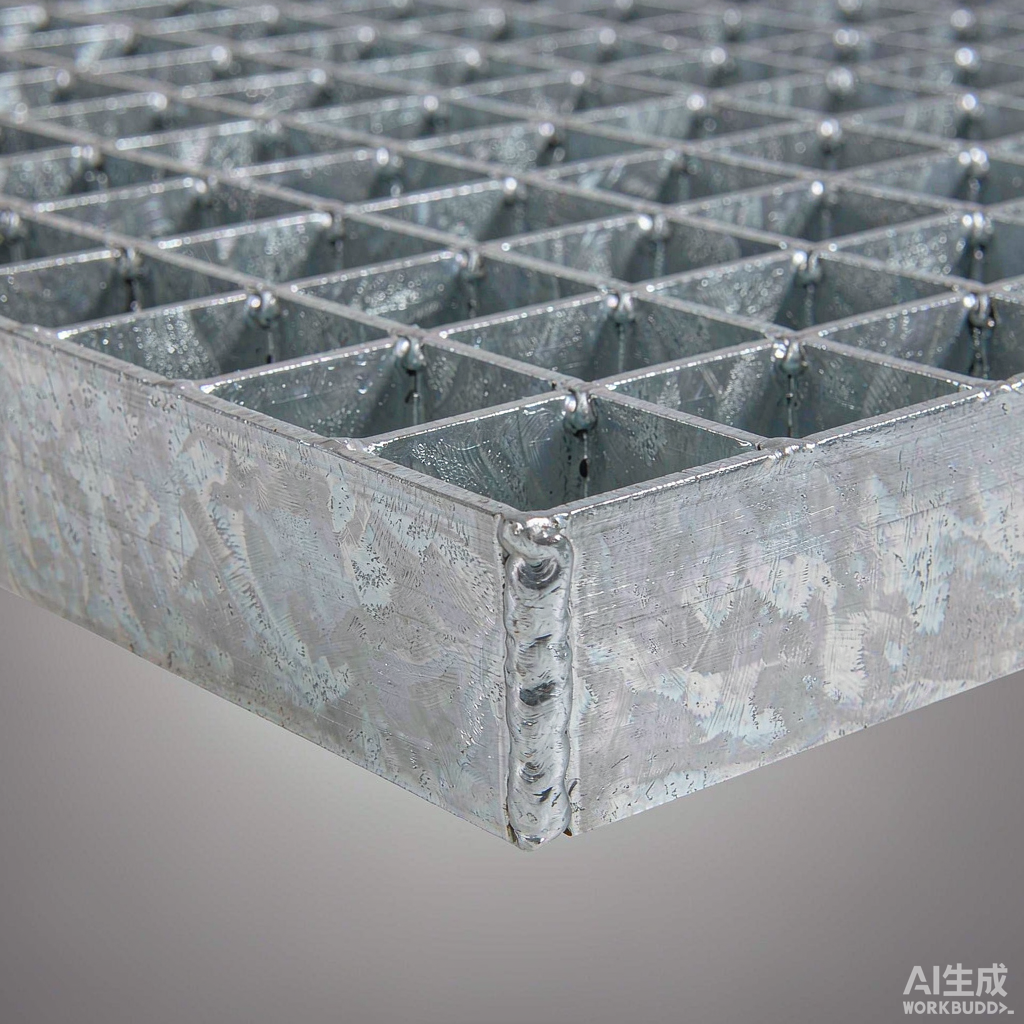
- Stair tread fabrication with welded or bolted carriers, nosing options
- Pre-assembly of clips, anchors and support steel into kit form for site speed
Everything is auditable
Third-party inspection (SGS/BV/TÜV) welcome at any stage. MTC per EN 10204 3.1 ships with every order by default.
✓
ASTM A36 — carbon structural steel bar and plate
✓
ASTM A123 — hot-dip galvanizing, 70–85 µm zinc coating on bearing bars
✓
ASTM A1011 / Q235B — flat bar feedstock with mill certificates
✓
NAAMM MBG 531 — load & deflection tables (uniform + concentrated load, L/200)
✓
EN 1090-1/-2 — structural steel execution, CE-marked assemblies
✓
ISO 9001:2015 — quality management system, audited annually
✓
MTC (EN 10204 3.1) material test certificate with every shipment
Ordering terms at a glance
1 pallet (approx. 20 m²) for stock sizes; custom sizes from 100 m²
15–25 days after drawing confirmation
20GP ≈ 26–28 t · 40HQ ≈ 26 t (varies with panel size)
FOB Shanghai / Ningbo · CIF & DDP available on request
T/T 30% deposit, L/C at sight for orders over USD 50,000
Grating stair treads are steel-grating panels fabricated into stepped units with end carriers, pre-drilled and ready to bolt or weld to stringers. Unlike checker-plate treads, open mesh sheds water, ice, snow and oil — and the serrated variant keeps slip resistance when the surface is visibly wet.
Stair treads are a compliance product: OSHA 1910.25 fixes the load, EN ISO 14122-3 fixes geometry and slip class. Everything below is organized so your safety officer can sign off, and so your installer can bolt them up in a day.
What OSHA and EN actually require
OSHA 1910.25 (fixed ladders & stairs context) and the general walking-working-surface rule 1910.22 require: treads that support at least a 1,000 lbf (4.4 kN) concentrated mid-tread point load, uniform rise between 6″ and 9.5″ (150–240 mm), minimum clear width 22″ (560 mm) for normal service stairs, and a slip-resistant surface in wet locations.
EN ISO 14122-3 adds geometry classes and slip classes: rise 160–225 mm, going (tread depth) ≥ 210 mm for normal access, and surface slip class measured per DIN 51130 (R9–R13, oily-to-extreme). Our serrated treads test at R12–R13 depending on bar profile — data sheet available with every order.
- Rise (R): vertical step height, 160–225 mm EN / 6–9.5″ OSHA — treads are made to your measured rise ±1 mm.
- Going (G): horizontal depth — 241 mm (9.5″) standard matches a 165–190 mm rise with 2×R+G in the comfort band.
- Nosing: a 25×3 flat bar welded proud of the front edge — improves both slip and step visibility; checkered-plate nosing optional.
- Carriers: flat-bar end plates pre-drilled 2×Ø13 mm for M12 bolts, or blank for welding.
Serrated vs plain: the trade
Serration (the notched top edge of bearing bars) roughly doubles wet slip resistance (R10 plain → R12/R13 serrated) at a cost of 10–15% load capacity in the same bar section — usually corrected by stepping up one bar size. Plain treads remain correct for clean, dry, indoor stairs and for food areas where serrations trap soil. See the serrated grating page for the full capacity-loss table.
Ordering treads correctly
The RFQ that avoids rework has five numbers: clear width between stringers, rise, going, stringer type (channel / plate), and fixing (bolted / welded). Send those plus quantity and material — we return treads pre-drilled to your stringer layout, plus the matching fixing hardware if your stringers are grating-supported.
Frequently asked questions
Are grating stair treads OSHA compliant?
Serrated or plain treads?
What tread width do I need?
Bolted or welded carriers?
Can you match a tread I am replacing?
Do you supply FRP treads?
What is the difference between grating treads and checker plate treads?
Get a quote within 24 hours
Include panel size, load requirement and quantity — or just upload your drawing. Our engineers respond with a price and a load check.
Attach your file, then send the form — your email client will open with the details pre-filled. For files over 10 MB, email sales@promptbarn.com directly.
✓ Your email client has opened with the RFQ details. Didn't open? Write to sales@promptbarn.com.