Welded Steel Grating
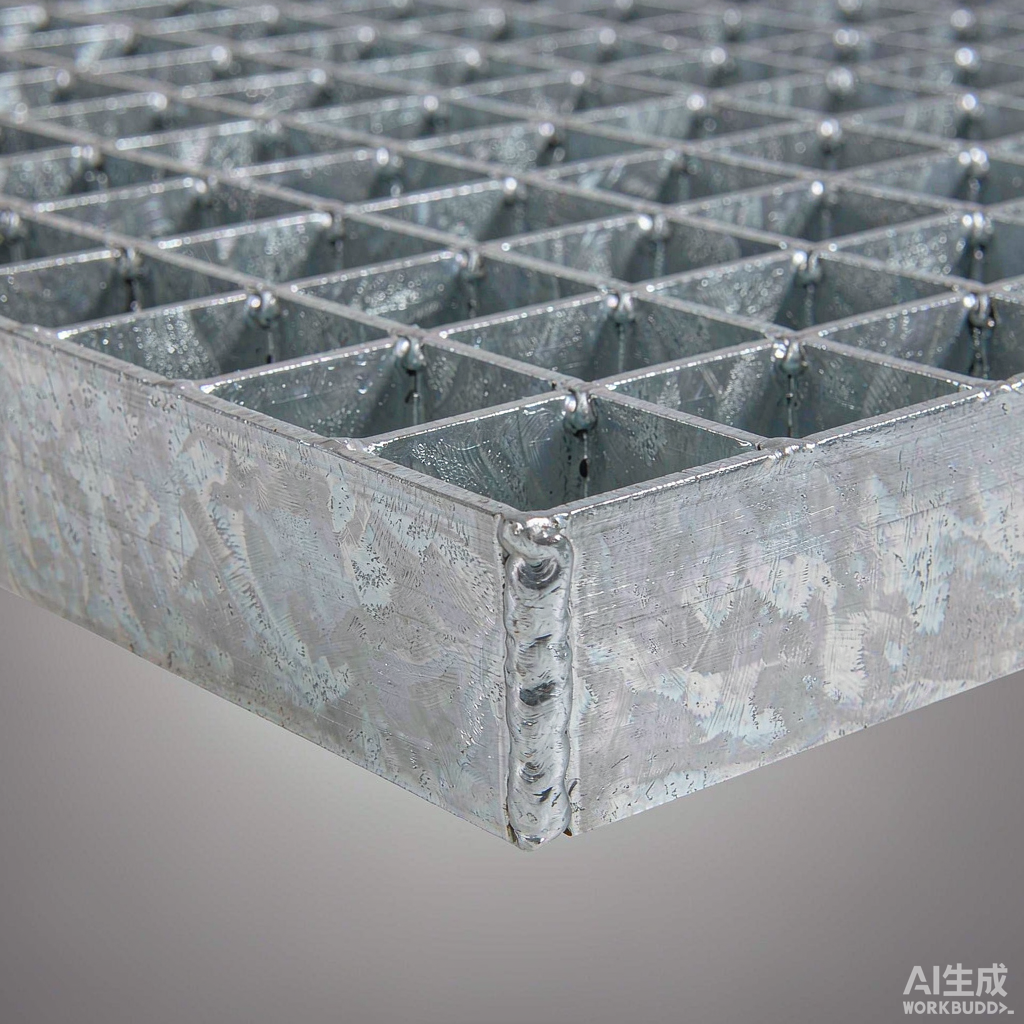
Resistance-welded steel grating — bearing bars and twisted square cross bars fused at every intersection. The strongest-per-kilogram and most economical grating construction: 80% of all industrial floors.
Get a Quote Download CatalogWelded vs press-locked vs riveted — the decision table
Screenshot-ready. Every dimension below is a standard tooling size — custom spacings are cut to your drawing at no extra mold cost.
| Criterion | Welded | Press-locked | Riveted |
|---|---|---|---|
| Construction | Resistance-welded joints | Bars forced into slotted holes | Cold rivets at intersections |
| Load capacity per kg | Highest | Medium (flat bars) | Medium |
| Bearing bar geometry | I-profile / plain flat | Flat only | Plain flat |
| Cross bar | Twisted square — torsion stiff | Flat or square | Round or square |
| Relative cost | 1.0× (baseline) | 1.1–1.3× | 1.4–1.8× |
| Best for | Industrial floors, walkways, stairs | Architectural, flush appearance | Retrofit / heritage, rivet-matched repair |
Aluminum cannot be welded into grating (HAZ weakens 6061-T6) — see the aluminum page; FRP is molded or pultruded instead.
Choose your construction and material
Each family has its own load table, finish options and lead time.
19W4 Welded (30/100)
The standard industrial walkway — see full section table.
View series → Product FamilyHeavy Welded 50/50
Forklift and wheeled plant traffic.
View series → Product FamilyGalvanized After Weld
Complete assemblies dipped — coating inside every joint.
View series → Product FamilyWelded Stainless
304/316L with pickled & passivated welds.
View series →Four material systems, one factory
Zinc thickness is measured per ASTM A123 (70–85 µm), salt-spray tested to 1,000 h. Stainless is pickled and passivated; FRP resin is matched to your chemical media.
| Material | Specification | Best For | QC Note |
|---|---|---|---|
| Carbon Steel, Hot-Dip Galvanized | Q235B / A36, zinc 70–85 µm per ASTM A123 | Walkways, platforms, trench covers, stair treads — the default choice | 1,000 h neutral salt-spray test before white rust |
| Stainless Steel 304 / 316L | AISI 304 (indoor / general chemical), 316L (marine / chloride) | Food processing, pharma, offshore, chemical plants | Passivated and pickled finish, 316L for >3% chloride media |
| Aluminum 6061-T6 | Mill or anodized finish, riveted or press-locked construction | Weight-critical platforms, water treatment, architectural meshes | ≈ 1/3 the weight of steel at comparable spans — cannot be hot-dip galvanized |
| FRP / Fiberglass (GRP) | Molded (isophthalic / vinyl ester) or pultruded profiles | Electrolytic areas, sewage plants, coastal platforms | Non-conductive, non-sparking, corrosion-free alternative to metal |
Welded grating load table (carbon steel, 30/100)
Values calculated to NAAMM MBG 531 with deflection limited to L/200. Need a stamped calculation sheet for your span? Ask in the quote form.
| Bearing bar (mm) | U-load @1m (kN/m²) | U-load @1.5m (kN/m²) | C-load @1m (kN) | Max span @ 4.8 kN/m² |
|---|---|---|---|---|
| 25×3 | 6.6 | 2.9 | 3.1 | 0.90 m |
| 32×3 | 11.0 | 4.9 | 5.1 | 1.15 m |
| 32×5 | 18.3 | 8.1 | 8.5 | 1.30 m |
| 40×5 | 28.7 | 12.8 | 13.3 | 1.50 m |
| 50×5 | 44.9 | 20.0 | 20.8 | 1.90 m |
| 65×5 | 67.4 | 29.9 | 31.2 | 2.40 m |
Welded joints carry the full section: unlike press-locked bars, no cross-bar slot removes bearing-bar metal. NAAMM MBG 531 basis, L/200.
Where welded steel grating works hardest
Reference projects available per industry on request.
Plant & mezzanine floors
The default industrial flooring — welded 32×3 upward.
Elevated catwalks
Long spans with minimum support steel.
Stair treads & landings
Welded carrier plates bolted to stringers.
Trench covers
Banded welded panels in galvanized or stainless.
Loading docks & aprons
50/50 heavy welded under forklift traffic.
Equipment screens & cages
Notched welded panels bolted around machines.
Send a drawing, receive a finished panel
Upload DXF or DWG with your RFQ — we return a dimensioned shop drawing for approval within 24 hours. No approval, no production.
In-house fabrication
- Cut-to-size from DXF / DWG drawings — band saw and plasma, ±2 mm tolerance
- Notching and cutouts for pipes, cable trays and manholes in any shape
- Banding (closed ends) in flat bar or checkered plate, toe plates to EN ISO 14122-3
- Curved and radial panels for tanks, towers and architectural projects
- Stair tread fabrication with welded or bolted carriers, nosing options
- Pre-assembly of clips, anchors and support steel into kit form for site speed
Everything is auditable
Third-party inspection (SGS/BV/TÜV) welcome at any stage. MTC per EN 10204 3.1 ships with every order by default.
✓
ASTM A36 — carbon structural steel bar and plate
✓
ASTM A123 — hot-dip galvanizing, 70–85 µm zinc coating on bearing bars
✓
ASTM A1011 / Q235B — flat bar feedstock with mill certificates
✓
NAAMM MBG 531 — load & deflection tables (uniform + concentrated load, L/200)
✓
EN 1090-1/-2 — structural steel execution, CE-marked assemblies
✓
ISO 9001:2015 — quality management system, audited annually
✓
MTC (EN 10204 3.1) material test certificate with every shipment
Ordering terms at a glance
1 pallet (approx. 20 m²) for stock sizes; custom sizes from 100 m²
15–25 days after drawing confirmation
20GP ≈ 26–28 t · 40HQ ≈ 26 t (varies with panel size)
FOB Shanghai / Ningbo · CIF & DDP available on request
T/T 30% deposit, L/C at sight for orders over USD 50,000
Welded steel grating is made the way it sounds: bearing bars are fixtured at pitch, a twisted square cross bar is pressed between every pair, and a 100 kVA resistance welder fuses each intersection — hundreds of joints per panel, each one at full parent-metal strength. This page shows the process, and the honest engineering comparison against press-locked and riveted alternatives.
How the welding line actually works
Flat bearing bar coils are cut to panel width and fed into the line; twisted square cross bars drop from an automatic magazine into the bar gaps; hydraulic electrodes clamp and weld every intersection in a walking-beam sequence — roughly one weld per second. The finished mat is straightened (the welding heat introduces minor twist), edge-flattened, and then either painted, hot-dip galvanized, or sent to fabrication for cut-to-size work.
Because the joints are resistance-welded (not filler arc welds), there is no weld spatter and no added metal — the seam is the fusion zone itself. This is why welded grating delivers the highest load per kilogram of any construction: nothing weakens the bearing bar.
When press-locked is genuinely the better call
Press-locked grating slots the cross bars into punched bearing bars and presses the joints mechanically. It looks better — flush flat bars, perfect lines — which matters in architectural and visible public installations. It also handles aluminum and stainless in appearance-driven projects. Its structural weakness: the punched slots remove bearing-bar web, so identical sections carry 10–20% less than welded. Choose it for looks; choose welded for structure.
Riveted: the retrofit option
Riveted grating is the pre-1950s construction still specified for heritage retrofits and for matching existing riveted floors in refineries and utility plants. It is slower and more expensive to build today — 1.4–1.8× welded cost — with no load advantage. We fabricate it purely for matched-replacement projects.
Quality controls specific to welding
Our in-house QC on welded panels: weld integrity (every 50th panel destructive-tested at one joint), bar squareness (diagonal tolerance 3 mm per meter), pre-galvanizing surface prep per ASTM A385, and a final straightness check on a flat bed. The MTC, galvanizing certificate and weld test record ship together.
Frequently asked questions
Welded or press-locked — which is stronger?
What is the “W” in 19W4?
Can welded grating be stainless or aluminum?
Do the welds rust before the bars?
Is welded grating removable for maintenance?
Why is welded the cheapest construction?
Get a quote within 24 hours
Include panel size, load requirement and quantity — or just upload your drawing. Our engineers respond with a price and a load check.
Attach your file, then send the form — your email client will open with the details pre-filled. For files over 10 MB, email sales@promptbarn.com directly.
✓ Your email client has opened with the RFQ details. Didn't open? Write to sales@promptbarn.com.